Moving Wax Around the Hive with Dave Wade (390)
Dave Wade joins Beekeeping Today to discuss his fascinating experiments exploring how honey bees move wax throughout the hive. By providing supplemental wax and using colored wax to track its movement, Dave has documented how colonies recycle and relocate wax for comb construction, brood rearing, honey capping, and hive maintenance. Along the way, he shares practical insights on drawing comb, managing honey-bound colonies, and helping bees build comb later in the season.


Beekeepers often think of wax production as something that simply happens when colonies build comb. But what if bees are constantly moving wax throughout the hive, recycling it from one location to another as colony needs change? This week, Jeff and Becky welcome Massachusetts beekeeper Dave Wade to discuss his observations and experiments exploring how honey bees utilize and relocate wax within the colony.
Dave’s journey into beekeeping began nearly twenty years ago when concerns about pollination of backyard fruit trees led him to a local bee school. Since then, he has become an active member of the Worcester County Beekeepers Association and developed a reputation for practical experimentation and careful observation in the bee yard.
 Dave’s journey into beekeeping began nearly twenty years ago when concerns about pollination of backyard fruit trees led him to a local bee school. Since then, he has become an active member of the Worcester County Beekeepers Association and developed a reputation for practical experimentation and careful observation in the bee yard.
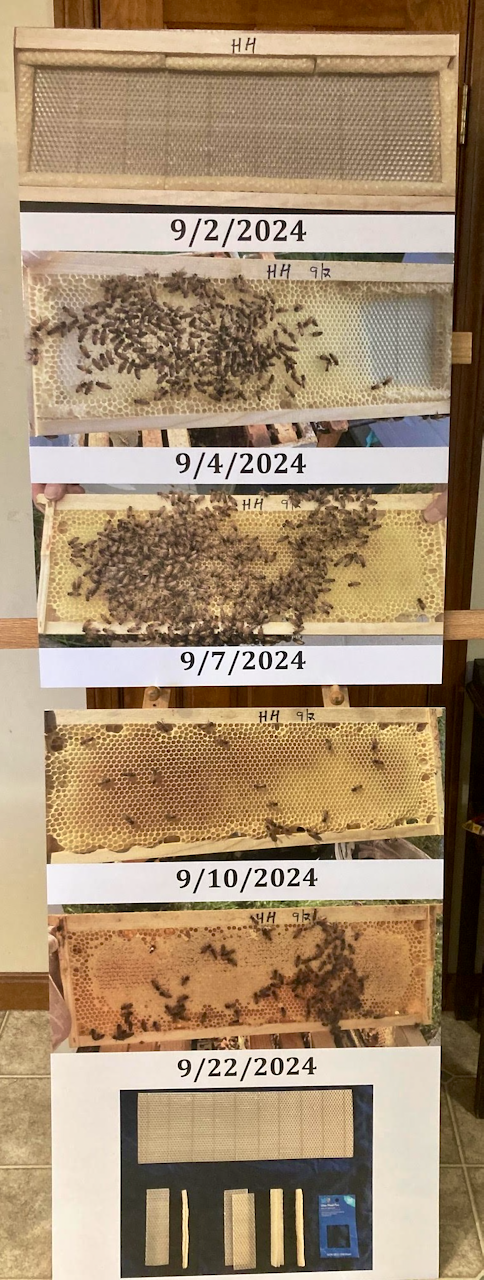
The discussion focuses on Dave’s work providing supplemental wax directly to colonies. Using strips and rolls of beeswax foundation placed inside frames, Dave has observed colonies rapidly incorporating the wax into comb construction, brood nest expansion, honey storage, and comb repairs. His experiments suggest that bees readily utilize available wax resources, especially later in the season when natural wax production slows.
Dave shares results from several years of observations, including the use of colored wax to visually track wax movement within colonies. Collaborating with researchers including Dr. David Tarpy, Dr. Michael Smith, and Dr. David Peck, Dave has documented evidence that bees relocate wax significant distances throughout the hive, supporting brood rearing, honey capping, and comb construction.
The conversation explores seasonal wax production, comb reduction, honey-bound colonies, package bee development, plastic versus wax foundation, and practical methods beekeepers can use to encourage comb building later in the season. Dave also discusses how supplemental wax may reduce colony energy expenditures and potentially improve colony productivity.
Whether you’re establishing new colonies, drawing foundation, managing honey-bound hives, or simply fascinated by honey bee behavior, this episode offers a fresh look at one of the colony’s most important building materials.
Websites from the episode and others we recommend:
- Honey Bee Health Coalition: https://honeybeehealthcoalition.org
- Project Apis m. (PAm): https://www.projectapism.org
- The National Honey Board: https://honey.com
- Honey Bee Obscura Podcast: https://honeybeeobscura.com
Copyright © 2026 by Growing Planet Media, LLC

______________

Betterbee is the presenting sponsor of Beekeeping Today Podcast. Betterbee’s mission is to support every beekeeper with excellent customer service, continued education and quality equipment. From their colorful and informative catalog to their support of beekeeper educational activities, including this podcast series, Betterbee truly is Beekeepers Serving Beekeepers. See for yourself at www.betterbee.com

This episode is brought to you by Global Patties! Global offers a variety of standard and custom patties. Visit them today at http://globalpatties.com and let them know you appreciate them sponsoring this episode!

As a beekeeper, you want products that benefit you and your bees. When you choose Premier Bee Products, you choose hive components that are healthier for bees and more productive for you. Because we believe that in beekeeping, details make all the difference. Premier Bee Products: Better for bees. Better for beekeepers. Use promo code PODCAST for 10% off your next online order.

APIS Tactical is a beekeeping brand focused on innovation. We create a wide range of gear for beekeepers of all types—whether you’re managing a few hives or working bees every day. We combine science and artistry to create purposeful, hardworking gear. We’re here to help you care for your bees with confidence, so you can focus on what matters most—your hive.

Thanks to Strong Microbials for their support of Beekeeping Today Podcast. Find out more about their line of probiotics in our Season 3, Episode 12 episode and from their website: https://www.strongmicrobials.com

HiveIQ is revolutionizing the way beekeepers manage their colonies with innovative, insulated hive systems designed for maximum colony health and efficiency. Their hives maintain stable temperatures year-round, reduce stress on the bees, and are built to last using durable, lightweight materials. Whether you’re managing two hives or two hundred, HiveIQ’s smart design helps your bees thrive while saving you time and effort. Learn more at HiveIQ.com.

We’d like to thank Vita Bee Health for supporting the podcast. Vita provides proven tools for controlling Varroa—from Apistan and Apiguard to the new VarroxSan extended-release oxalic acid strips—helping beekeepers keep stronger, healthier colonies.

Thanks for Northern Bee Books for their support. Northern Bee Books is the publisher of bee books available worldwide from their website or from Amazon and bookstores everywhere. They are also the publishers of The Beekeepers Quarterly and Natural Bee Husbandry.
_______________
We hope you enjoy this podcast and welcome your questions and comments in the show notes of this episode or: questions@beekeepingtodaypodcast.com
Thank you for listening!
Podcast music: Be Strong by Young Presidents; Epilogue by Musicalman; Faraday by BeGun; Walking in Paris by Studio Le Bus; A Fresh New Start by Pete Morse; Wedding Day by Boomer; Christmas Avenue by Immersive Music; Red Jack Blues by Daniel Hart; Bolero de la Fontero by Rimsky Music; Perfect Sky by Graceful Movement; I'm Not Running Away This Time by Max Brodie; Original guitar background instrumental by Jeff Ott.
Beekeeping Today Podcast is an audio production of Growing Planet Media, LLC
** As an Amazon Associate, we may earn a commission from qualifying purchases
Copyright © 2026 by Growing Planet Media, LLC

Moving Wax Around the Hive with Dave Wade (390)
Nathan Keach
Hello, this is Nathan Keach. I'm from Kentucky. I have 13 colonies and welcome to Beekeeping Today.
Jeff Ott
Welcome to Beekeeping Today podcast presented by Betterbee, your source for beekeeping news, information, and entertainment. I'm Jeff Ott.
Becky Masterman
And I'm Becky Masterman.
Global Patties
Today's episode is brought to you by the bee nutrition superheroes at Global Patties. Family-operated and buzzing with passion, Global Patties crafts protein-packed patties that'll turn your hives into powerhouse production. Picture this. Strong colonies, booming brood, and honey flowing like a sweet river. It's super protein for your bees and they love it. Check out their buffet of patties, tailor-made, for your bees in your specific area. Head over to www. globalpatties. com and give your bees the nutrition they deserve.
Jeff Ott
Hey, a quick shout out to Betterbee and all of our sponsors whose support allows us to bring you this podcast each week without resorting to a fee-based subscription. We don't want that, and we know you don't either. Be sure to check out all of our content on the website. There, you can read up on all of our guests, read our blog on the various aspects and observations about beekeeping, search for, download, and listen to over 300. past episodes, read episode transcripts, leave comments and feedback on each episode, and check on podcast specials from our sponsors.
You can find it all at www. beekeepingtoday. com. Thank you, Nathan Keach, for that great opening from the floor of the North American Honey Bee Expo back in January.
Becky Masterman
It was a lifetime ago.
Jeff Ott
Seems like it. It seems like it. Well, thank you, Nathan, for helping us kick off today's exciting episode. Becky, it is definitely We're into the season. No more thinking about it. We're doing it. How are your bees?
Becky Masterman
The bees are looking really good. I I just thought of something though. The North American Honey Bee Expo where so many bee keepers get So much equipment. I bet it's all on the colonies by now, right?
Jeff Ott
Yeah, it's definitely.
Becky Masterman
So everything that I've purchased this year is It's been put out and so it's ki it's kind of fun. All all of us are trying new honey supers or new varroa control or new frames, new new foundation. New boxes, all sorts of fun stuff. Um we've got what seven six months to the next expo where we stock up on equipment to use again in January.
Jeff Ott
Start making that list now.
Becky Masterman
Well that's good. So yeah. Yeah. Your bees good?
Jeff Ott
Uh yeah, I just it seems like the swarming season just never ends. So I will be honest with you. We're recording this a couple weeks earlier than it's released. Twenty minutes before we started recording. Yeah, I got another swarm. So it's just like, what I can't leave now.
Becky Masterman
So you know, couple of thoughts. A lot of times if you even if you're you know trying to prevent swarming but you still have the problem, a lot of times what it it indicates you've got a really, really great nectar flow. Which is probably what happens. Also, I mean, I wonder if you should look at different lines of bees that might be a little less prone to swarming. Like Caucasians supposedly are a little bit less prone to swarming because of their buildup.
Jeff Ott
Yeah, and these are have been overwintered colonies that I've been having issues, obviously um overwintered colonies. And they're all carniolans.
Becky Masterman
Oh, I've got something to tell you about that.
Jeff Ott
Oh yeah?
Becky Masterman
I I was literally just talking to a queen producer about it and swarming and he said, I have no data, but I I totally trust people who manage thousands of colonies. But he said Second year carnival and queens seem to be a little bit faster on pulling the trigger and swarming. So is uh do you have data on that for me
Jeff Ott
Yeah, I will give you a second data point on that.
Becky Masterman
But I thought that was interesting because we we were oh I was talking I was telling you about a colony. They haven't s swarmed, but they definitely just built up and filled out and caught me by surprise. And we were talking about that. And he just mentioned it's just those little fun, fun things that are based on lots of experience. So second year cardio in Queens Maybe that's your problem.
Jeff Ott
Oh, I can guarantee you that's part of the problem. Uh I think I'm gonna do some requeening mid season or just after the honey flow and You start getting them ready for the fall. I have one really defensive colony that based on the location they are at at a family farm area. They're not around the playground, but you know you don't want to have anyways, yeah. Requeened.
Becky Masterman
I know this is probably not what you were trying to do, but what I do with the defensive colony is I will break it down into five nucs. So too small to have a big defensive force and then they're easier to requeen.
Jeff Ott
Oh, that's a good idea.
Becky Masterman
Then you get to have more colonies. So yay.
Jeff Ott
Yay, more colonies? The joys of midsummer, mid season, beekeeping. It's always something in it.
Becky Masterman
Well, I think maybe one of us is having more fun than the other.
Jeff Ott
Yeah.
Becky Masterman
Jeff, we have another question for the Hive IQ Hive Tool, and I need you to answer it.
Jeff Ott
Okay, I'll try.
Becky Masterman
So, I mean it says hi Becky and Jeff, but let's just pretend it says hi Jeff. It says I use oxalic acid vapor Mold vaporization in my apiary and understand the importance of a properly fitted respirator with the correct cartridges for organic vapors and particulates. He goes on to ask, how often should the cartridges be replaced? What are the replacement schedules And is there a recommended interval for replacing these filters when used for oxalic acid vaporization at what signs indicate it's time to replace them? Well, I hope we don't get to those signs 'cause that's scary.
Yeah.
Jeff Ott
Well, and that's from who?
Becky Masterman
And this is from Ed. Ed Chen in Buzz Riot Apiaries in Irvington, New York. What a fun Oh my gosh. Have you seen the logo? Yeah it's Buzz Riot Apiaries?
Jeff Ott
That's a that's a wild board.
Becky Masterman
Already like I already like Ed. Okay.
Jeff Ott
Yeah, I have to ask him what kind of if if he plays. It's a bee with a guitar.
Becky Masterman
It is a bee with a guitar. And quite the hairdo. Okay. So Jeff, how can you help Ed? And and keep Ed safe and maybe some other listeners
Jeff Ott
Yeah. Well that's an important question because when you're using the vaporization, you don't want to inhale it. oxalic acid powder, you can touch it, it's not gonna burn you. It's when it hits the wetness that it turns to an acid and it can burn you. And when you vaporize it it turns into the nanocrystals or s really small crystals of oxalic acid and then and you breathe it in into your lungs and into your mucous membranes. And anybody who's worked with OAV oxalic acid vapor will tell you that if you take off your mask too soon, you breathe it in, it's not a very pleasant feeling.
I have a friend who told me that.
Becky Masterman
I but I I bet you have a friend. Okay.
Jeff Ott
So so yeah, really good question. He included the 3M respirator that he uses in the cartridges and which happens to be the exact same Respirator and cartridges I use. You do want to replace those organic filters on a regular basis I went to the 3M website and did some other research on the internet and for oxalic acid where it's not like a paint. What you're really protecting yourself against is the really small particles, what they call a P100 size filter. And it removes those particles before they can embed in your lung those little particles of oxalic acid.
The recommendations is to set a schedule you can do once a year at the end of every season, throw away the cartridge, and then say in January or February put a new cartridge on. Technically, you could use it several seasons, but what happens is with these cartridges, the organic part of that cartridge starts to break down and you really don't know it. So you want to Just replace it on a regular basis and you'll be fine. It's the obvious signs like breathing through it and it's hard to draw air, then that's probably a good sign that you need to replace it.
So Ed once a year. I would do it once a year, unless you're doing a lot of OA vaporization in like on a commercial scale, then I would recommend even twice a year. And before we close this off, Becky, I I do want to correct what I said earlier in this because I don't want to re-record this entire conversation. is that I casually said that you can touch oxalic acid powder and obviously you don't want to play with oxalic acid powder. You want to wear nitrile gloves Latex gloves when you're working with any of these chemicals in and around the bee yard or A, even in your shop.
Your skin has moisture on it it will react with the OA and cause skin irritation, might burn you. And especially you don't want to get it into any cracks in your skin. That would be painful as well So, best bet, always wear protective gear with the oxalic acid. Wear eye protection, make sure you don't get it in your eye, and make sure you use a respirator, make sure you don't inhale the vapor or the powder dust.
Becky Masterman
So basically be afraid, be very afraid.
Jeff Ott
It's it's not something to play with.
Becky Masterman
That's well said.
Jeff Ott
One of the joys of swarming season is watching colonies build out the frames and and build wax. And that's one of the things in y you think about it and you think how all the bees hang uh chain together and and pull the wax flakes and build the beautiful comb. But you know, a lot of times they reuse wax. Our next guest has some fun experience with this.
Becky Masterman
My favorite is when you find a frame of brood, sealed worker brood, and you can just see a rainbow of actual capping color. And it's just it just goes to show you that yes, they are reusing it and yes, it does change color over time. So I'm excited to s talk to somebody though who actually Puts a little effort into learning more about it.
Jeff Ott
So Today's guest is David Wade, and we'll be talking to him right after these words from our sponsors.
Betterbee
Looking to re-queen a hive, make a split, or Or build your own nucs this season? Betterbee has Mated Queens available for shipment or pickup in Greenwich, New York. Choose from Q-Tick Kine Queens, bred for hygienic mite resistance and strong honey production. gentle carniolan queens, known for managing hide populations with the flow, or better bees locally raised northern queens, selected for winter hardiness, disease resistance, temperament, and honey production. Order your queens today at betterbee. com
Apis-Tactical
This episode of Beekeeping Today podcast is brought to you in part by Apis Tactical. A beekeeping brand focused on innovation. They use new designs, new materials, and new ideas to bring more joy to beekeeping. Apis Tactical creates a wide range of gear for beekeepers of all types. They use new Designs, new materials, and new ideas to bring more joy to beekeeping. Their products are built with purpose and they're already getting attention well beyond the US, with beekeepers in Europe discovering them through this podcast. If you're looking for well Made beekeeping gear from a company that understands the work.
Take a look at Apis Tactical. You can learn more at apis-tactical. com.
Jeff Ott
Hey everybody, welcome back. Sitting around this great big virtual beekeeping today podcast table stretching from coast to coast, really. In Sturbridge, Massachusetts, we have Dave Wade in Minnesota. We have Becky and I'm, of course, I'm in Olympia, Washington. Dave, welcome to the show. Nice to be here today. Thank you for having me.
Becky Masterman
Thanks so much for taking time during the beekeeping season to join us.
Jeff Ott
Dave, we invited you here today to talk about some of the experiments you're doing as a hobbyist beekeeper with how bees move wax around the colony. And that's really fascinating what you're doing But before we get down into that, tell us a little bit about yourself, about your beekeeping, how you got interested in bees and And then we'll go from there.
Dave Wade
Certainly. Central Massachusetts, rural area. The I'd have to say I got into it. We have fruit trees in the backyard. My wife noticed we weren't getting many apples. She looked into it and said, Hey, it's a pollinator issue. And this was twenty years ago. Pollinator issue. So what do you do? You take care of it. My wife looked it up The local county beekeeper association here, Worcester County Beekeeper Association. They of course have a Bee School. She signed me up for bee School. And of course she came back and said she kinda laughed at me when I got home, Dave, were there twenty people there?
I'm like, no, Christine, there were about there were about two hundred people there. Was it even even twenty years ago? A lot of people, big interest. Worcester County is the biggest county here in Massachusetts. I've since become a board member. We have the oldest one of the oldest county beekeeper associations in the country. We celebrated 125 years last year Hobby beekeeper. And Jeff, when you mentioned bees move wax around, my what I've been doing is providing them with wax, which we'll talk further about, giving them supplemental wax, just no different than we feed supplements now in our food for the bees.
I supplement with wax. And the beautiful thing is I'm not a scientist. I have no scientific background. When I give my presentations and Done it all over New England and a number of them, Zoom meetings, presentations. I tell people, you, you can do this. Not no scientific background. Everything you see simple, may take a little bit of work. But you can do it. And I usually have anywhere from six, seven hives. It's usually d and I'm in Massachusetts. We always have that challenge of getting through the winter, getting through the cold months And I'm getting better at it, I have to say, either better and more lucky.
I did w I went into the winter with not ten hives, came out with nine, which was beautiful. The problem the downside of that is I'm doing experiments, I'm buying packages, I'm up and put get catching swarms, I'm up to twelve now. I work for a living. It's obviously difficult to keep up with the hives. It definitely keeps me busy. I'm doing my experiments. It is definitely motivational when I go to the conferences and such and people know what I'm doing. People are following me and actually using the methods that I've tried. I go up people come up to me and say, Dave, I tried this, it worked for me.
I was shudder shudder when I when somebody comes up to me thinking, Oh, I tried and it didn't work. Nope. Most times they say, Yes, I tried it and it worked. It was a game saver Beautiful.
Becky Masterman
What was the problem that you had that you needed to solve when you started working with Wax? What problem were you trying to solve?
Dave Wade
Yeah, I would say it wasn't didn't start out as a problem, it started out as an observation. Observation and since I started giving these talks, I noticed a lot of people, I'd have set up to say more than fifty percent, are using plastic foundation you don't r y see it as easily as you do if you use wax foundation. I use wax foundation in my hives. And what you see is on the bottom of the frame wax is missing. As you go through the season, the bottom of the frame the bottom of the frame, whether it be a brood frame, a honey frame, you may see wit missing wax.
The bees, when I I'd have to say one of the first things I figured out cappings. I was putting my cappings on the inner cover after I strained out the honey. And I would notice the bees did work the wax a little. They usually made a mess up there. These if you left it too long they might actually start storing honey up there. And I had a another issue, another experiment I would say, with a mentee of mine. She had a plastic she had plastic foundation, new beekeeper. She couldn't get the bees to go up into the second super.
I know a lot of people have issues with that Especially if you don't roll any extra wax on. Couldn't get the bees to go up. What I tried with her hives, she didn't have any wax foundation, of course. I brought some over, ripped it up, and put it kind of on the tops of the frames basically giving the bees what they needed. If they're not producing it, I give the bees the wax. The other thing I learned is that the female honey bee she'll produce that wax from about 12 to 18 days old. Uh she has four four pairs of wax glands on her abdomen.
The big deal with it is she only produces up until about the my mentor used to always tell me, Dave, after the fourth of July you're not gonna get much cone belt out. The bees don't really produce the wax. In my collaboration since I discovered this, Dr. David Tarp he's been great. He had me on his YouTube channel over a year ago. He was saying that they use the summer solstice as the cutoff period where the bees really slow down, stop producing that wax. So it was one of those things What do you do? Here I am in Massachusetts, a cold climate.
We have basically three months, April, May, June, to get all your comb built out. How do you get the bees to build out cumb comb July, August, September? It's simple concept I'd have to say afterwards. No different than you building a shed or something. You run out of wood. What do you do? You get all wood. The bees aren't producing that wax. What do you do? You give it to them. And then it was a hit or miss. It was a experiment, give it to them where they need it. Eventually I figured out how much wax to give them and give it give it to them on the inside of the frame.
If you keep it on the inside of the frame, they used it. When I had that Mentee when I put it on top of the frames, They chewed it, they manipulated it, but they kept it on there. It really is crazy that they have to have it like within the frame.
Jeff Ott
And what form are you giving them the wax? Are you using rolled foundation or are you giving them, you know, the one ounce, eight ounce blocks of wax? How are you providing wax to the bees to work with?
Dave Wade
I gave them what I had at that point. which was basically I use nothing but mediums. I had medium foundation with the support wires. I basically pulled out the support wires. It gave me what I call a slice of wax. It's about an inch and three inch inch and three quarters wide I basically took that and I I call it a roll, but it was it's hard to roll up. If you ever try to make candles, it's hard to get that roll started. I basically Fold ink. First of all, he folded it. I basically fold it twice.
And then insert that. Put that on the inside of the inside of the frame and that's what they were using. A block of wax, I don't think the bees the mandibles can manipulate that wax. You it would be beautiful if we could just put a block of wax in there in the hive and the bees would use it. It's not that easy. It's about placement and eventually I figured out volume. At first I was using one of those slices of wax around the whole inside perimeter of the frame. When they built it out, it was beautiful.
A week later I went in and like wow. How did the bees do this? How did we we never knew the bees could do something like that. We add wax, we figure the bees are gonna make a mess. They built it out beautifully, the cone, but the depth of those cells were only about halfway out. So I figured out, okay, volume. I needed to add more wax. It was basically two slices of those wax rolls along the whole inside perimeter. What I'm working on now, this year, is plastic frames one, across plastic foundation. and I'm trying to use whole sheets of wax.
That's a little bit more of a challenge because if you have the rolls too too large and they actually touch one another, picture picture inside of your hive Langstroth hide with the frames. The frames are pretty close together to to maintain that bee space. If you create too much space, which I did have to pull out a frame or two to t to fit all these in there. the bees kind of weld the wax together on the top and then they build that funky comb hanging down from there. So now I'm working on making the rolls small enough which I figured out I'm doing more of an oval than I am a circle, because you can make the with the volume of wax, you can roll it up in an oval, which doesn't take as much room sticking out.
Becky Masterman
That is what I'm working on right now. Where within the colony are you placing these frames?
Dave Wade
I did find that when I first did this experiment was in August, back in 2024. The bees that time of year, August, July, August, September, a major when you go in your hives, majority of your bees are down low, down in the brood chambers. Up above you have your honey f honey supers, you get bees coming in exchanging the nectar. Not much activity up there The lower you go down, what I did in the 2024 experiments really was placing frames with the wax rolls right directly either in the brew chambers, which is beautiful and use nothing but mediums.
You can move your versatility, it's great or right above the brood chambers. That was the best place. Just like when you have a t I use eight but if you had a ten frame hive, if you put those frames on the outside, the one, two, nine, ten place, just when you build just when you're starting out a new colony. those spots are last for the bees to build out. Center of the hive, towards the bottom, near the brood, and you'll see also if you follow my presentations. ABF has a good one if you remember. Just recorded it last March.
The I did a whole experiment last spring which worked out well. I took two hives control Where I just put the single sheet of wax foundation in the middle. I did two, every other frame received wax rolls, and then I did two other hives where every single hive, every single frame. Whenever I added supers had wax rolls. My hypothesis was that providing that a spring package with that extra wax is going to build out the colony faster, stronger, ended up with more bees in those hives. more honey and the bees definitely took off using that wax.
Becky Masterman
Okay, and then let's get back to wax rules. Those you are taking from your beeswax foundation frames and you're cutting in between the wires.
Dave Wade
Yeah, that I wouldn't say cutting Becky. The if you when you buy the The sheets, most of unless you're doing cut comb wax foundation where there are no wires, they most of and I've been getting mine from different companies. The why the wire is easy enough. There's one direction. My my twenty-three-year-old son figured it out. I had it course but put my kids to work. The you basically if you pull out the wire, it makes it so you just like perforation where you can break the sheets apart and they are about an inch and three quarter inch wide.
So picture the inch and three quarter plus whatever the medium frame is five and six sixteenth or five and a quarter whatever it is for height And but like you said, now I'm trying to do whole sheets. It maybe not the full medium. You may have to cut off an inch. I think I had an inch and a half of them doing mediums, I'm still working off the math. It's one of those things though, when I did this in 2024, I I did weigh the frames. I weighed the frames that I was putting the wax on, how much wax I was adding in the regular typical frame that the bees built out.
Mine are a little bit heavier wax wise, which I tell people I'd rather have a wax rich hive than a wax poor hive because the when I did that experiment with the six hives, the two that I add kept adding the wax rules to, you didn't have any of that space along the bottom. The bees didn't have to steal that wax and move it somewhere else. Michael Smith down at Auburn University, I've been collaborating with him also, he sent me to a research uh paper that one of his graduate students did back in 2021 on comb comb reduction, comb reduction research paper.
He basically the research the graduate student tracked it, tracked comb building over season. Top Bar Style Hive but the bees naturally built it out. No no foundation. He tracked up until they used he and Smith and Dr. Tarpy both used the summer solstice as the cutoff time when the bees typically stop or slow down building producing wax. And from that research he did figure out that five out of the six of the hives that he was d that he was d working on they did slow d slow down, if not stop, building out the comb.
Then after that he could track it with a camera. The wax the end of the comb, the edge of the comb on the bottom got more narrow. The bees were stealing the wax off the bottom Uh Dr. Smith, Michael Smith thought it was the bees taking it and moving it somewhere else, most likely for cappings. The bees aren't producing it. How do you get cappings? You ta they are taking your bees, if you watched your comb, especially later on in the season. It the bees are moving that wax when they're not producing it.
Becky Masterman
Right. We were just talking about that. You can see a a rainbow of of actual colors within one root frame if you pay attention.
Jeff Ott
Let's take this opportunity to take a quick break and we'll be right back and talk to David Wade a little bit more about the movement of blacks throughout the colony.
Premier Bee Products
Beekeeping is demanding work. The last thing you need is equipment that can't keep up. That's why Premier Bee Products builds every frame and hive body in our South Dakota factories with one goal in mind. Reliability when it matters most. From our beefy pura frames to our natural profila high bodies with rough interiors, we design for long life, in the field and in the colony. Because we believe that in beekeeping, deep Details make all the difference. Premier Bee Products better for bees, better for beekeepers. Visit online at PremierBeproducts. com or call us today. Use promo code PODCAST for 10% off your next.
online order.
StrongMicrobials
Beekeepers, if you're looking for a smarter way to support colony health, take a look at bee bites from strong microbials. Bee bites are a new protein pair Made with spirulina, chlorella, and targeted probiotics, designed to support nutrition without creating new problems in the hive. With 15% protein, bee bites are unique because they do not attract small hive beetles. If you've ever battled infestations during feeding, Strong Microbials has been supporting beekeepers and farmers since 2012, developing high-quality commercial probiotics and nutritional supplements you can trust. Learn more about Bee Bites and their full line of bee nutrition.
at strongmicrobials. com.
Becky Masterman
Welcome back everybody. Now Dave you've done some I have to say fun, but some experiments using actual dyed wax so that you could really see what the bees are doing. Could you talk a little bit about the work you're you've done there?
Dave Wade
Sure, Becky. I was just gonna bring that up when you mentioned rainbow. The beautiful thing about my club that I belong to, Worcester County Beekeeper Association, we're such a large organization. We have over fifteen hundred members that We're able my our program manager, Ken Warchell, is great. He's able to get big name speakers coming out and giving presentations once a year. David Harpey was one of the ones. And whenever whenever these speakers come out, I make a point to introduce myself. Here's what I'm doing. Maybe you've heard about what I've been doing. You may have seen one of my articles in American V Journal, whether it be June of twenty-five or April of twenty-sixth.
And the cool thing was one of the first times after that August 2024 timeframe, I think it was somewhere around December or so, Dr. David Tarpy was out from North Carolina State. And I brought some life. I had my hat laptop actually spoke to him around at lunchtime. He took a a great interest in it, which was gr which was perfect It was one of those things, me not being a scientist. He's like, Dave, I can see it. You got all these photos, but as a scientist, we gotta prove it. And I mean I have I probably had three, four hundred photos at that time of the bees, me putting the wax roll rolls on there.
Two days later you could see it missing them from one spot, usually in the middle of the frame, and then you see it being built out in the middle He's like, okay, Dave, we have to prove it. And so he got to thinking, how do we prove it? And he said, well, maybe colored wax. I'm like, I don't want to put colored wax in my life. I did break down. I did I did buy some from Betterbee last fall. During one of the uh one of the meetings, Better P g came out and I bought some red and some blue.
Cool thing was, and it w cool thing was, and it will be in American Bee General the next time. The wax that Betterbee sells uh is for candles, for making candles. It it was a I think it's a it's a deep sheet, obviously without the wires. I did put it in over a couple of overwintered hives. The red came out beautifully because if I could show you the red red photo sometime. I mean it you could see even in the spring hive when the bees are producing a lot of wax, I thought it would come in be pink in the middle because the bees would be adding their own wax, you can see it's it's pretty clear that on those medium frames where I added the wax rolls top and bottom.
It appears that they only used my wax that I put in there. Even on the frames next to it on both sides looks pretty cool too. You can see a good amount of red there. I have some brood frames with this red on top of the brood The blue kind of faded out pretty quickly for some reason. The red was much more vibrant. When I sent that to Dr. Tarpey, I think he was happy to see that. Uh Dr. David Peck was great, but he was happy to see that also because it's showing that the bees are moving the wax.
Even two frames away, you'd see little spots. It's telling me how far they're moving the wax. The cool thing is I'm gonna do this later on in the season, after that July early July time frame when the bees aren't producing wax. I want to see how far the bees are taking the wax that I'm providing and moving it to do cappings. I wouldn't be surprised if it's two three frames two three four frames away, up and up and down and below and next to it. The bees I we don't know how much the bees are moving wax around when they're stealing it, but when I'm providing it, but see how much they're doing it.
I even did a experiment late in the season, I want to say October, where I put just the sheets of wax hanging between in up in a honey soup, way up on the top, broke my own rules there, putting it way up where there aren't many bees. I wanted to see if they'd use that wax for capping. The honey w I don't know if the honey was ready to be capped or not. Provided the bees with the sheets. And I'm gonna say within a few days you could see a pattern, especially in the middle. where the wax was chewed away from the sheet and there it was used for cappings on the honey.
I still ha I still haven't been able to get an answer from any of the scientists. D does it help in a northern climate for moisture, for humidity, if we cap off all the honey in the in the hive going through the winter? Because if it does, how simple it is late in the season to just put a few sheets of wax in there, give the bees that wax to do the counting Assist in the camping, I should say.
Jeff Ott
Let me ask real quick if you can give us a a photo or two that we can put in the show notes on the website and and our listeners can go
Dave Wade
I found that you could I have I when I give my presentation I carry around a a pouch that my wife gave me. I will go around during the season with rolls of wax, t small pieces, maybe one of those slices. Bottom of the frame missing, I will just insert that roll in there. Just push it in, it sticks in there pretty well. The base will repair the frame. Varrock sand, I used Vrox sand last year. Some people had you had an issue if you didn't move the strip. The c to maintain bee spees bee space, the bees may have chewed behind the strip.
I showed actually that's gonna be in the American Bee Journal in July in the letter to the editor. Your Eugene uh Makovich was nice enough to agree to put that in the letter to the editor so people beekeepers by the way can uh fix that issue. Whereas I put a small piece of wax wherever the divot was, we'll call it the gap where the bees chewed it out, put it in there, top and bottom. And within I want to say three days, you could see nice and clean. It it always amazes me that the the old wax and the frames you look at, it's it's not the new pristine wax.
You see the bees have been walking all over it. You put the new wax in there, they will put the new wax over the old wax. To the point where the situation is the varsan They did a fine job repairing it.
Becky Masterman
I have a lot of those frames. And and it happens fairly quickly. It's it's it's not even after an extended use of it. I I'm curious, is it have you figured out how to do this with burr comb so that we could just scrape the tops of our frames and then put that comb in to different locations? And does that work?
Dave Wade
When I see any bridge comb or bird comb in my hive or even uh till lately I even saw some uh drone brood on the bottom. I s it's kind of n nasty, but it squished out the the the bees that I did well in there and put that wax back in there. You'd be amazed. If you put it usually up in the top corners, I'll put it in the bees will chew it up. Not always the prettiest cone. You don't want to leave the the actual sir the hexagon the comb form because if it's facing down the bees are just kinda they'll attach it and leave it there.
Crush it up They'll they'll repair it. The also with the wax, the beautiful thing is about having given this presentation for well over a year now. I'm getting feedback. I had a couple of beekeepers who were telling me, I always get I often was getting the question, what do I do with my rendered wax? Rendered wax, wax that people melted down. They have that block that's usually sitting on their desk and they if you don't make candles or some type of cosmetics or hand cream or something, you don't do anything with that wax. The beautiful thing is Betterbee and other companies actually sell a silicone mold.
If you've seen this, the bright orange, Betterbee has it. You can melt down your wax. You can you're basically making your own foundation sheets I haven't done it yet. I am gonna be doing it hopefully before July, before I go to the E uh EIS uh conference. That I've seen people do it. They basically did the exact same thing I was doing with their own wax. You're taking your own sheet of wax You're rolling, folding that up, you're putting that on the inside perimeter of your frame. You're reusing the wax you have sitting around the house.
It'd be nice to have beekeepers recycle their wax more like that
Jeff Ott
Is this your primary experiment you've been doing? You sound like you were getting ready to do another type of experiment with your bees or andor the wax?
Dave Wade
Yeah, now it's just the plastic foundation frames where uh where I've got the deeps, uh I don't like working with plastics. I did my second year of beekeeping I I dropped I enjoy having I prefer and I think the bees. prefer the wax foundation. I'm using plastic, like I said, because I I've seen more than I don't know what the number is. I'd have to say it's gotta be more than for the hobby beekeepers, more than half of them now are using the plastic foundation. I want to see if that works out well. The funny thing is, when I did it last year with the spring experiment, as I said, I put wax rolls in every frame and two of the hives.
I didn't have any debris in the bottom. The bees were using all the wax, uh it appeared, once again for Dr. Farkt Tarve there it appeared that the bees were using all the wax I gave them. This season I'll have to send you this photo also and I just sent it to Dr. Peck uh today. There was on the bottom, the bees just about finished building out the two packages I put in inserted into these two plastic foundation frames, hives. The there's a lot of debris. Actually it was probably a sixteenth of an inch of chewed up wax.
I mean really fine like sawdust on the bottom. The bees were you and I did weigh it, it was like six ounces And I want to say with the wax rolls that I put in there were actually the the total wax the weight of the wax rolls that I put in the hives were 36. 8 ounces. So 36 ounces And the amount of wax debris on the bottom, I I weighed it, was about six ounces. So six ounces out of thirty-six. So the bees used most of the wax I put in there, I believe. whatever reason.
If you think about it, it's probably it might be one of those things where pli when I did it last year, picture your foundation being just wax. All right. You'll use the exact same wax on my rolls. For the bees to chew it up and it's and apply it wax the wax is I'm sure a pretty simple comp deal for them When you're asking them to take your your natural beeswax and apply it to that plastic frame, maybe it's one of those deals where They're then maybe they're mixing some of their own wax in there because they don't want to just use the wax that I'm providing.
I gotta figure that out. My guess would also be when I do this later on in the season, I'm gonna repeat this in mid probably August. The bees think about it, the bees aren't really producing wax in August. If I give them the wax, they need so a certain amount to build that cone all the way out. I'm expecting that they're not gonna have all that debris. They're gonna use most of the wax, if not all the wax I give them, if that makes sense. So that's what I'm working on now, getting the bees to to use plastic foundation and see how well they do with that.
And the the silly thing is too, I I've been meaning to do it, whereas I mentioned I put the sheet of wax in between the frames to get them the cap I'm gonna I I'm gonna try it in some of my overwintered hives in a in a brood area. I'm just gonna instead of putting the wax rules on the on the fi on the frame, I'm just gonna put a couple of sheets on both sides of the both sides of the frame and see if they actually use that. Mostly they you'd be surprised. Whenever you put wax anywhere in that general area brood area.
If it's something they can manipulate, something they can grab with their mandibles, not that block of wax, they're gonna use it. I've seen videos where people put z wax shavings or something in their hog on the bottom. The bees drag it out. Put it in the frame. You break off something as you go into the hive. You break you get comb on the bottom. You get burr comb Put it back on the frame. The bee you will see the bees chew it up. Take a photo before you do it. The the the bazing thing with technology, it it's great.
If this had been many years ago Who carries a camera around with them, correct? Now we all do, technically, because we've been on our cell phones. Once again, I'm not a scientist. The the great thing was when I started doing this uh back in August of 2024, I took photos of the frame that I was gonna put in the hive with the wax rules on it. And then I took photos a week later when I was surprised to see what they did That I do encourage people. The beautiful thing is it's your hive. Do whatever you want.
Oh, not that you can cause problems, but do whatever you want do whatever you want in your hive, but d but It's keep track of what you're doing and you'd be surprised. I I tell ya some of these days I went out and checked the highballs like Christmas morning. I'm like, really? This actually happened And I do have to add, when I get my presentation, it's not all positive. You go in this time, some things don't work out. All data is good data, they say. The one thing one thing that definitely didn't work out, I had Some beekeepers in their honey supers will pull a frame.
Pull a frame because they want to make it easy for uncapping. Hit a 10-frame high if you pull out a frame, you get nine nine frames. just so you can easily take the uncapping knife and cut off the cappings. Some people, like I said, I tried in I pulled a frame in the middle. And I did add to wax rolls on a frame that completely filled up with nectar. And I wanted to see, okay, are they gonna build out that comb a little bit further like I wanted them to. I went in and it was a mess.
They built comb hanging down everywhere. I know part of it was because I probably gave them too much wax. You'd be surprised, just a little thin roll of wax, how far it actually goes, because if you look at how your your cells, how thin those cell walls are. It doesn't take a lot of wax. The cool thing is too, when I when I noticed it when the bees were Using the wax I gave them last year to to build out some honey frames. I'm always amazed. You go in there, they're constructing the same time bees are bringing in nectar.
As as it people we don't we don't want somebody bumping into us when we're working on something, right? But the bees are all over it in an area, building up the comb while they're filling it. One of the biggest things I found as a use for this Honey-bound. I had a gentleman I was mentoring a couple of years ago, that same year, 2024. He had he had split a split his hives. He didn't have enough comb in September. We need that obviously big cluster of bees going into our winter up here in this cold climate in Massachusetts.
His problem was honey-bound. Any of the new beekeepers know if they're not aware of that term. Honey-bound means the queen the bees are bringing in nectar backfilling, filling in where the queen should be laying her eggs. We remedied his problem He had a medium super on top of this deep 10 frame that was that had the wax foundation it. The bees weren't going up and building out that comb. We took that whole 10 frame super put the wax rules on it in early September, probably the first week of September. And he did actually he did have two deeps.
He did but they weren't going up to the medium. What we did is, once again, where are all your B's and down below? What we did is we sandwiched it between the two deeps. You took the medium in between the two deeps. The bees within a few days you could see were already building out the comb and already putting nectar in the in those comb in that comb, which means they were not putting it into the brood. chamber, which was beautiful. That did solve his problem. He didn't have any other comb. That's what we did to fix fix his situation.
That worked out well for being honey-bound.
Jeff Ott
It's really good.
Becky Masterman
It's a trick you can definitely use even when you're supering, it's just you can bottom super and get them to encourage them to dry out the foundation, but it makes sense in in an emergency that you could use it in a different way as long as you provide them the resources that you do not have in September. So that's interesting.
Dave Wade
Then and think about it. Those twelve to eighteen day year old bees that are produced and the bees that are produced the majority of the c the wax are t between twelve and eighteen days old. What are those 12 to 18 day-year-old bees doing? I haven't gotten a scientist to give me an answer for this one yet. Late season. After that early July period. What are those twelve to eighteen day-year-old bees doing? They're not ready to go out in the field yet. Why not put them to work and tell people, build build out some comb this year that you can use next year?
Especially if a new beekeeper, you know, you got one or two hives. We are asking that small cluster of three pounds of bees when you get your package to build out the entire colony. You have a lot of bees if your hive is strong late season. Put them to work. The other experiment I'm gonna do is I'm gonna take the entire eight frame deep and I'm gonna get that and I'm gonna try to get all for eight frames built out between probably August and September You know usually that time of season your outside frames, your one and your ten, usually have honey in it.
Pull those frames. Put in two frames with wax rolls, put them towards the middle. I wouldn't put a put a brood frame between them. Don't put don't put two frames side by side with the wax rolls. Put them in there. I I would guess within a week or so, those two frames are gonna be built out. Pull out another two, put in another two. I would like I said, I would think within a month and a half maybe I can get the whole eight or if you've got a 10 frame beef, you can use those frames the following year.
That's the beautiful thing. Put those put that large colony of bees to work. If that makes sense. You want to start a neat nuke the following year. Get them to build out the wax. You'll see you if you sell nucs, this is a s probably a speedier way to get your comb build out in your nucs Give them the wax. Plus they e I'm sure they e they're consuming less.
Becky Masterman
I love how you've said a couple of times that you're not a scientist, but If you're doing science, I'm just gonna say you're at some level a scientist. And I'm curious how you if you have any special way that you're marking or tracking your frames. Because if I if I need to go back to a colony, I'll just do a and check on a specific frame. I'll just take my head tool and maybe make an X. Um but are you are you marking your frames that you're putting into colonies at all to help you track things
Dave Wade
Meg when I was first doing this it started out with A and B. A bee and it's funny looking at some of my and that's another beautiful thing about the cell phone, you get the date you get the date of the photo, which is which is perfect. The date of the photo, I'd I'd give it I'd And it's funny because when I first started doing this, I wasn't keeping track any other way. Taking the photo, writing the letter on it. got to the point, well, geez, did I leave on s S or T or end up putting double letters on there and then I put, you know, numerous things on there.
Okay, three star, four, whatever differentiated but the beautiful thing is taking a photo. More than anything I'd be taking photos. I have the Sharpie with me. Put a simple date on there with the Sharpie. Different I should say a letter on there with the Sharpie. Mark up your hive as much as you want. The funny thing is the bees The bees with the sharpie you gotta be quick because they don't like it. They'll go right to the t tip of the sharpie and uh I don't know what they're trying to do to it, may sting it or something, but you gotta be quick.
And then when you take your photo it's always tricky 'cause you gotta bang 'em off or get 'em off and they always want to seem to walk across the spot where the you've got the letter on there.
Becky Masterman
Sharpies are are good things. They will stay in that frame for a long time. I've had frames where I've switched out the foundation and I still have the last year on the found on the on the top, so it can get a little messy
Jeff Ott
So Dave, just real quick on on when you're talking about rolling the foundation, are you rolling it tight when you roll it? I know that you know, if if it's The warmer the wax is, the easier it is to roll. But do you roll it tighter than not tight or is it a real loose roll? How do the bees prefer it? If you went too tight it's not gonna work.
Dave Wade
It's gonna it's gonna be hard for them that to manipulate it And this being a podcast, not a video, the when I when I first started doing it, I'm sorry, no better way of explaining it, it's like you're rolling up a cigarette or something. to the point you're putting your fingers in there, taking the sheet, rolling out, folding it over once, folding over twice. I did eventually find something in my kitchen called a dough slicer or dough cutter, I think. where it's got a flat edge, metal flat edge, not sharp. The beautiful thing about that was is I can easily fold it over once, flip it and fold it over again and just kinda maybe roll it a little bit on the table.
It's not a solid it's not a solid piece when you give it to them. I don't think they could use it if it was solid. Yeah, not solid, just enough for them to grab on. You may it's amazing too when you see them if you do use wax foundation, they're able somehow to chew through the bottom of that wax. They don't need an edge just so to speak. Somehow they're able to chew through it
Becky Masterman
I'm curious, have you done any kind of a cost analysis as far as like how much you need to invest in order to get a frame of uh, you know, one new medium frame of foundation and and or sorry, comb on foundation.
Dave Wade
I do have a good slide for that when I give my presentation and it's still on Dr. Tarpey's uh YouTube channel. When I did this back in 2024, when I bought the twenty-five pound bat box of wax foundation, I want to say it was about a dollar ten per wax sheet. I wanna say I had to use it was ended up to being like three dollars a sheet. I'm sorry, three dollars a frame. Medium frame, three dollars. Picture you have your ten frame, that's thirty dollars a frame. The thing is when you're building out those frames, it's not for one year.
You may get five years out of that. And I did the I did the math with the you make extract from that honey frame twice a year. You make it as much as I think somebody told me I'm as much as three pounds of honey per Extraction. So you make as much as six pounds of honey per year over a five year period. Thirty pounds of honey that you just spent thirty dollars for So if you spent obviously if you're you know even you're selling your honey for ten dollars a pound, we're talking you know three hundred dollars or whatever the math is there it cost effective wise.
And I also use it basically there's no free lunch, I tell people. The bees, if you're not feeding them, and if it's if it's late season, you're probably not feeding them anyway, all that nectar that they're bringing in that they're consuming And I use the uh Dr. Tarpy was using ten ten he uses ten pounds of nectar, honey, sugar syrup to produce a pound of wax. All that they have to produce to make that wax goes into play also because if you're spending the money on whether you're spending on sugar syrup or honey that you're gonna extract, why not give them the wax?
I also when I went to the ABF conference in January, there's a gentleman, a medical doctor, an MV, that gave a presentation on the health of the bees. We had a good conversation afterwards because I what I went where I was going with it When I did that experiment with the two hives that I gave them all the wax, those bees probably had to produce very little wax from their bodies during that whole season. What benefit what is it to the bees? would they possibly live longer? W when we had the discussion, it came about to as an example, uh a woman who has children, it does take off it may take off some of her lifespan because of all the stress on her body.
the stress or e exertion the bees have to do to produce all that wax. What if your bees are living so it we're talking numbers here. What if your colony, all the bees, if you gave them that extra wax, are living a little longer? Say t even in something simple two days. Two days longer for fifty thousand bees, those bees going out and giving and pollinating It may be of a benefit to your highs, just giving them some supplemental wax from that point of view.
Jeff Ott
Something to think about. Well this has been really fascinating, Dave, going back to my foundation days and just wondering why are they chewing off the bottom of the foundation? I don't Now I understand why that's uh I just thought they were just doing despite me.
Becky Masterman
Not not really. Taking it personally.
Jeff Ott
Yeah, taking it personally. But no, this is really fascinating and we know it happens, but to actually see it with the colored wax like you did, it was just enthralling. So I appreciate you taking the time on this busy time of the year to come and talk to us and to our listeners about your experiments with your bees and the movement of wax throughout the hive.
Becky Masterman
Yeah, super interesting. Thank you, Dave.
Dave Wade
Yeah, well it's it's great to get the exposure. And I I also always tell people, if you learned something, share it with others. You never know. This may have been something that somebody figured out long ago and just didn't share it. So When you figure something out, you learn something new, even even not just necessarily in beekeeping, anything in life. You learn something, share it with others and see see where it goes from there. We will all learn it's amazing we're all learning new things all the time about bees.
Jeff Ott
Well thanks a lot, Dave. We look forward to having you back down the road to hear what else you've discovered. Thanks for having me. Have a good day. We rarely talk about wax. So much unless it's in connection with candles or maybe contests or something, but the production and movement of wax throughout the hive by the colony is A fascinating topic.
Becky Masterman
I heard something last year about drawing out late season comb and that was I think it was oh I I won't say it in case I'm wrong, but it was about providing a really low drip of syrup late in the season to mimic to mimic a n a nectar flow. Anyway, I just it's it's interesting that be it's a problem beekeepers have been trying to solve you know, if you have foundation and need comb, it you know, y we we don't make it. So it you need the bees to do it. So it it's it's great that there's there's hope for people out there.
Jeff Ott
This conversation's interesting because this last spring with the swarms uh had a swarm move into a hive that was empty and I said, woohoo, a self-catching swarm. And about a week after they were in, I wanted to just do a quick inspection. And I separated the top box from the bottom box and, you know, of course, there were some missing frames in the bottom box. Oh, and they had started the draw out comb, right? Yep. Yep. And and I started looking at the comb, but it wasn't the pearly white like we're used to. It was kind of a gray.
Interesting. They must have been repurposing comb from other places and building out new comb in that space. And it's like So topical with this conversation, that's what they were doing.
Becky Masterman
Yeah. No, it is it's something if you think about it when people talk about even, you know learning about bees in your second, third, fourth year, we don't do a ton of of of comb production. We try to get people so that they keep their f frame spaced close together when drawing it out so that you don't have you have nice even frames, but we don't go much more in depth about comb. So it's it's good to have the conversation
Jeff Ott
And that about wraps it up for this episode of Beekeeping Today. Before we go, be sure to follow us and leave us a five-star rating on Apple Podcasts or wherever you stream the show. Even better, write a quick review to help other beekeepers. Discover what you enjoy. You can get there directly from our website by clicking on the reviews tab on the top of any page. We want to thank Betterbee, our presenting sponsor, for their ongoing support of the podcast. We also appreciate our longtime sponsors, Global Patties, Strong Microbials, and Northern Bee Books for their support in bringing you each week's episode.
And most importantly, thank you for listening and spending time with us. If you have any questions or feedback, back, just head over to our website and drop us a note. We'd love to hear from you. Thanks again, everybody.
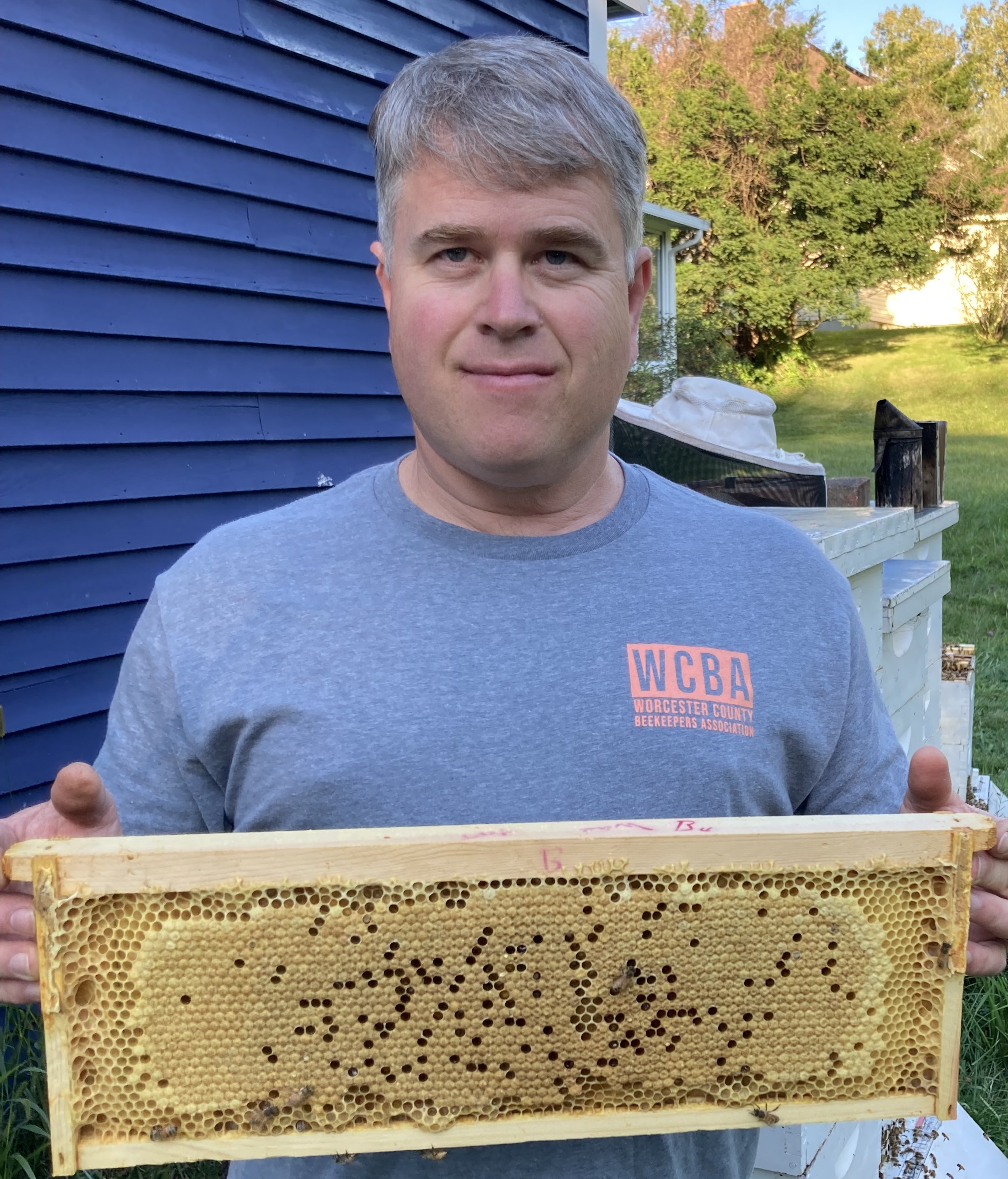
Hobby Beekeeper/Wax Experimenter
Dave Wade is a 20 year hobby beekeeper from Sturbridge, MA. He is a long time member and a newly elected board member of the Worcester County Beekeeping Association. The club recently celebrated 125 years. In August 2024, he discovered a method to get honey bees to build comb late season by providing them with strips of rolled up wax foundation. He was able to extend the comb building season through September, in Massachusetts. In 2025, he conducted an experiment with package hives in which he showed that providing spring packages with supplemental rolls of wax the hives grew stronger and faster than the control group.